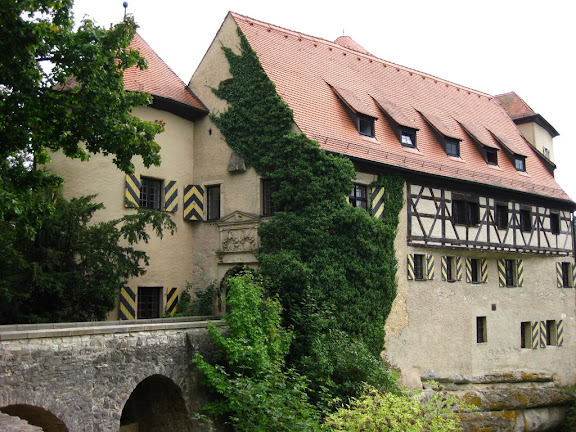
 I recently took a trip to participate in two of my dear friends' wedding. It was located at Burg Rabenstein (NOTE this page is in German but can be translated using Google Translator) in Ahorntal, Germany which is situated in the Franconian region of the country. The Burg is seated on top of a sloping hill, overlooking a gorgeous sea of trees and a windy river below. My under-powered, manual-shifting Panda car struggled to navigate up the steep, windy, one-lane road. As I approached it, though, my jaw dropped at the surrounding natural beauty.
Originally built in the 12th century, the Burg was destroyed and rebuilt in the 15th, 17th, 18th, and 19th centuries. Presently it is used as a hotel and event center; a school of falconry; and a beer garden. The interior has been restored to much of its former luster and decorum.
 Before the festivities began, I roamed through as much of the castle as I could with my camera in hand to photo journal the various rooms and artifacts inside. Check out the full album on my Picasa site.
A small band of wedding goers (including yours truly) went for what turned out to be a rain-soaked hike through the valley the afternoon I arrived. This included a tour of the caves that have formed underneath the structure. The Sophienhöle (or Sophie's caves) were discovered by the Rabenstein gardner, Michael Koch, in 1833. Sophie's cave is one out of four in the Klaussteinhöhlen-Komplex. They contain many intricate stalagmite and stalactite formations and are carefully maintained by private owners. Ahornloch and Klaussteinhöle, two of Sophie's sister caves in this system, are also open and available to be toured by travelers. The fourth cave, Höschhöle, is not accessible to the public.
 The wedding was a beautiful, two-day ensemble of German and American traditions. The setting, in the mountain valley of Ahorntal, was a scene out of a storybook. The further I drove on the German Autobahn from the Frankfurt airport (FRA) to the Burg, the more I felt like I was reaching back in time. I passed several villages that reminded me of scenes out of movies. The buildings were all made out of brick and plaster with the criss-crossing, dark wooden beams on the outsides. They were clustered together surrounding narrow streets that wound up and around them. And of course, there was the Burg itself, complete with bodies of armor and royal fixtures throughout its halls. If you're a medieval history aficionado and happen to be traveling through Deutschland, put this one on your list of stops!
Cheers, M@
Comments